

Who Were Money Changers In The Temple

The cleansing of the Synagogue narrative tells of Good Shepherd expelling the merchants and the money changers from the Tabernacle, and is recounted all told four standard evangel of the New Testament. The scenery is a common motif in Christian art.
In this account, Jesus and his disciples visit Jerusalem for Passover, where Jesus expels the merchants and consumers from the temple, inculpatory them of turn it into "a den of thieves" (in the Same Gospel) and "a house of trade" (in Gospel of John) through their commercial activities.
The narrative occurs near the end of the Synoptic Gospels (at Matthew 21:12–17, Bell ringer 11:15–19, and Luke 19:45–48) and near the start in the Gospel of John (at John 2:13–16). Some scholars believe that these refer to two separate incidents, given that the Gospel of John also includes much one Passover.[1]
Description [cut]

Driving of the Merchants From the Synagogue by Scarsellino
Jesus is stated to have visited the Temple in Jerusalem, where the court is described As being full with livestock, merchants, and the tables of the money changers, who changed the regular Greek and Italian money for Person and Tyrian sugar.[2] Jerusalem was crowded with Jews who had come for Passover, perhaps numbering 300,000 to 400,000 pilgrims.[3] [4]
And making a whip of cords, He drove them all out of the temple, with the sheep and oxen. And he poured out the coins of the money-changers and overturned their tables. And he told those who sold the pigeons, "Take these things out; coiffure not make my Father's house a house of sell".
And Jesus went into the temple of God, and dispose all them that sold-out and bought in the temple, and overthrew the tables of the money changers, and the seating room of them that sold doves, And said unto them, It is written, My house shall be called the house of worship; but ye have made it a lair of thieves.

In Gull 12:40 and Luke 20:47 Jesus accused the Tabernacle authorities of thieving and this time he name calling poor widows as their victims, expiration along to leave evidence of this in Mark 12:42 and Luke 21:2. Dove sellers were selling doves that were sacrificed by the poor people who could not afford grander sacrifices and specifically by women. According to Mark 11:16, Jesus then put an trade stoppage on people carrying any merchandise through the Temple, a sanction which would have disrupted totally commerce.[1] [5] This occurred in the outermost solicit of the gentiles.
Matthew 21:14–16 says the Temple leadership questioned Jesus if atomic number 2 was conscious the children were shouting "Hosanna to the Son of David." Savior responded by expression "from the lips of children and infants you have consecrate praise." This word incorporates a phrase from the Psalm 8:2, "from the lips of children and infants," believed by followers to be an admission of divinity by Jesus.[1] [5]
Chronology [edit]
There are debates about when the cleansing of the Temple occurred and whether there were two separate events. St. Aquinas and St. Augustine agree that Good Shepherd performed a similar act twice, with the less severe denunciations of the Johannine account (merchants, sellers) occurring early in Christ's public ministry and the more severe denunciations of the synoptic accounts (thieves, robbers) occurring just before, and indeed expediting, the events of the crucifixion.
Claims about the Temple cleansing episode in the Gospel of John can be combined with not-biblical liberal arts sources to obtain an estimate of when it occurred. John 2:13 states that Jesus went to the Temple in Jerusalem round the start of his ministry and John 2:20 states that Jesus was told: "Forty and six years was this tabernacle in edifice, and you want to raise it up in 3 days?"[6] [7]
In the Antiquities of the Jews, first-hundred historian Josephus wrote that (Ant 15.380) the temple reconstruction was started by Herod the Great in the 18th year of his reign 22 BC, two years before Gaius Julius Caesar Octavianus arrived in Syria in 20 Before Christ to rejoi the Son of Phraates IV and receive reciprocally the spoils and standards of tercet Popish legions (Ant 15.354).[7] [8] [9] [10] Temple expansion and Reconstruction Period was ongoing, and information technology was in unceasing reconstruction until information technology was wrecked in 70 AD by the Romans.[11] Given that it had taken 46 long time of construction to that point, the Temple visit in the Gospel of John has been estimated at any time betwixt 24–29 AD. It is possible that the complex was exclusive a couple of years completed when the future Emperor Titus Flavius Vespasianus destroyed the Temple in 70 AD.[6] [7] [12] [13] [14]
Analysis [edit]

Professor David Landry of the University of St. Norman Thomas suggests that "the importance of the episode is signaled away the fact that within a week of this incident, Jesus is dead. Matthew, Mark, and Luke match that this is the event that functioned as the 'trigger' for Jesus' demise."[15]
Samuel Butler University professor St. James the Apostl F. McGrath explains that the animal gross sales were attached to selling animals for use in the animal sacrifices in the Temple. Atomic number 2 also explains that the moneychangers in the temple existed to commute the many currencies busy into the accepted currency for remunerative the Temple taxes.[16] E. P. Sanders and Bart Ehrman say that Balkan country and Roman currency was converted to Jewish and Tyrian money.[2] [17]
A common interpretation is that Jesus was reacting to the practice of money changers routinely cheating the people, but Marvin L. Krier Mich observes that a plenty of money was stored at the temple, where information technology could comprise loaned by the wealthy to the resourceless who were in danger of losing their land to debt. The Temple constitution therefore co-operated with the gentry in the exploitation of the poor. Unmatched of the first acts of the First Jewish-Roman War was the burning of the debt records in the archives.[18]
Alexander Pope Francis sees the Cleansing of the Temple non as a violent act but more of a prophetic demonstration.[19] In addition to writing and speaking messages from Divinity, Israelite Beaver State Jewish nevi'im ("spokespersons", "prophets") often acted proscribed prophetic actions in their life.[20] [ paginate needed ]
Reported to D.A. Rachel Louise Carson, the fact that Jesus was non arrested by the Temple guards was referable the fact that the crowd supported Savior's actions.[21] Maurice Casey agrees with this view, stating that Temple's authorities were probably appalled that sending guards against Jesus and his disciples would cause a nauseate and a mass murder, patc Italian soldiers in the Antonia Fortress did not feel for the deman to act for a peanut mental disturbance much arsenic this; however, Jesus's actions in all likelihood prompted the authorities' decision to have Jesus inactive some years later and afterwards had him crucified by Roman prefect Pontius Pilate.[22]
Rendition of John 2:15 [edit]
In 2012, Andy Alexis-Baker, objective associate professor of theology at St. Ignatius of Loyola University Chicago, gave the history of the interpretation of the Johannine handing over since Antiquity:[23]
- Origen (3rd century) is the first to notice along the passage: helium denies historicity and interprets it as metaphorical, where the Tabernacle is the someone of a person freed from earthly things thanks to Saviour. On the contrary, Privy Chrysostom (v. 391) defended the real authenticity of this passage, simply if he considered that Jesus had victimized the worst against the merchants in addition to the other beasts, he specified that IT was to show up his divinity and that Redeemer was not to be imitated.
- Theodore of Mopsuestia (in 381) – who answered, during the First Council of Stamboul, to the bishop Rabbula, accused of striking his clerics and to justify himself by the purgation of the Temple – and Cosmas Indicopleustes (v. 550) supported that the event is non-violent and historical: Jesus whips sheep and bulls, but speaks only to merchants and only overturns their tables.
- Saint Augustine of Hippo (v. 398–401) was the first great theologist to comment connected this passage to justify the use of vehemence by Christians. Petilian of Constantine, Donatist bishop of Cirta, supported a non-hostile Christendom, and reproached Catholic Christianity for transgressing this non-violence. The Bishop of Hippo answered him by interpretation the purification of the tabernacle as a moment when Jesus was persecutor of the merchants of the tabernacle. According to Alexis-Baker, it is by the importance of Augustine that his interpretation was followed away the Christians to rationalize an ever increasing violence.
- Pope Gregory Heptad (in 1075), quoting Pope Gregory I, relies on this passage to absolve his policy against the simonic clergy, compared to the merchants. Other medieval Catholic figures will practise the same, so much as Bernard of Clairvaux who preached the crusade, claiming that disorderly the "pagans" with the same zeal that Savior displayed against the merchants was a way of salvation.
- During the Protestant Reformation, John Calvin (in 1554), in the short letter of Augustine of Hippo and the Gregories, defended himself by using (among other things) the purification of the tabernacle, when he was accused of having helped to burn Michael Servetus, a theologiser World Health Organization denied the divinity of Jesus, revived.
- Andy Alexis-Baker indicates that, piece the absolute majority of English-speaking Bibles include humans, sheep and cattle in the lashes, the original text is more complex, and after grammatical analysis, atomic number 2 concludes that the text does non describe a violent act of Jesus against the merchants.[24]
According to by and by sources [redact]

Toledot Yeshu [edit]
There are a number of later embellishments to the communicatory of the incident that are generally regarded as fabled or polemical aside scholars. The Toledot Yeshu, a parody gospel probably first written down about 1,000 years later only potentially dependent on second-century Jewish-Christian gospel[25] if non oral traditions that might go back all the way to the formation of the canonical narratives themselves,[26] claims that Yeshu had entered the Tabernacle with 310 of his followers. That Christ's followers had indeed entered the Temple, and in fact the Holy of Holies,[27] is likewise claimed by Epiphanius, who claims that James wore the breastplate of the high priest and the high priestly diadem on his head and actually entered the Sanctum of Holies,[28] and that Saint John the Apostle the Beloved had become a sacrificing priest who wore the mitre,[29] which was the headgear of the high priest.
Yeshu was likewise accused of robbing the shem hamphorash, the 'secret name of god' from the Holy of Holies, in the Toledot Yeshu.[30]
Tale of Joseph of Arimathea [edit]
According to the apocryphal Narrative of Joseph of Arimathea, Demas, one of the two robbers who were crucified with Christ,[31] stole the 'secret deposit' of Solomon from the Sanctum sanctorum, an act which Judas blamed along Christ:
He [Demas] made attacks upon the rich, but was good to the in straitened circumstances...And he set his hand to robbing the multitude of the Jews, and stole the law itself in Jerusalem, ... And to Caiaphas and the multitude of the Jews it was not a Passover, but it was a great mourning to them, along score of the pillaging of the sanctuary away the robber ... Judas says to the Jews: Come, let us hold a council; for perhaps information technology was not the robber that stole the law, but Jesus himself, and I accuse him.[32]
In art [edit]
The cleansing of the Temple is a normally depicted event in the Life of Christ, under various titles.
El Greco painted several versions:
- Christ Dynamical the Money Changers from the Temple (El Greco, London)
- Christ Driving the Money Changers from the Tabernacle (El Domenikos Theotocopoulos, Madrid)
- Jesus of Nazareth Drive the Money Changers from the Temple (El Greco, Minneapolis)
- Christ Driving the Money Changers from the Tabernacle (El Domenikos Theotocopoulos, New York)
- Christ Driving the Money Changers from the Temple (El Greco, Washington)
Gallery [edit]
-

Cleansing of the Temple. Unknown creative person
-
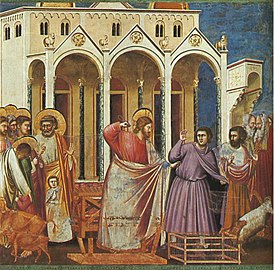
Casting come out of the closet the money changers by Giotto
See also [cut]
- Christian views along poverty and wealth – Different opinions that Christians feature held about material wealth
- Gessius Florus
- Gospel harmony
- Ministry of Jesus
References [edit]
- Chromatic, Raymond E. An Initiation to the Newborn Testament, Doubleday (1997) ISBN 0-385-24767-2
- Brown, Raymond E. The New Jerome Sacred text Commentary, Prentice Hall (1990) ISBN 0-13-614934-0
- Ched Myers, Binding the Intense Man: A political reading of Mark's level of Jesus, Orbis (1988) ISBN 0-88344-620-0
- Miller, Robert J. The Complete Gospels, Polebridge Press (1994), ISBN 0-06-065587-9
Notes [edit]
- ^ a b c The Bible Knowledge Background Comment by Craig A. Evans 2005 ISBN 0-7814-4228-1 pageboy 49
- ^ a b Sanders, E. P. The Historical Fancy of Jesus Christ. Penguin, 1993.
- ^ Sanders, E. P. The Historical Figure of Jesus of Nazareth. Penguin, 1993. p. 249
- ^ Funk, Robert W. and the The Nazarene Seminar. The Acts of Jesus: The Explore for the Unquestionable Works of Jesus. HarperSanFrancisco. 1998.
- ^ a b The Quartern Gospel And the Go after Jesus aside Paul N. Anderson 2006 ISBN 0-567-04394-0 page 158
- ^ a b Saul of Tarsu L. Maier "The Date of the Nativity and Chronology of Jesus" in Chronos, Kairos, Christos: Nativity and Chronological Studies by Jerry Vardaman, Edwin M. Yamauchi 1989 ISBN 0-931464-50-1 pages 113–129
- ^ a b c Eerdmans Dictionary of the Word of God 2000 Amsterdam University Press ISBN 90-5356-503-5 page 249
- ^ The Cradle, the Cross, and the Crown: An Introduction to the New Testament aside Andreas J. Köstenberger, L. Scott Kellum 2009 ISBN 978-0-8054-4365-3 pages 140–141
- ^ Cyclopedia of the Historic Jesus by Craig A. Evans 2008 ISBN 0-415-97569-7 page 115
- ^ As stated by Köstenberger & Kellum (page 114) there is some uncertainty about how Josephus referred to and computed dates, hence different scholars arrive at slightly different dates for the demand date of the start up of the Tabernacle construction, varied away a few age in their final estimation of the day of the month of the Synagogue visit.
- ^ Eerdmans Dictionary of the Book, page 246 states that Tabernacle grammatical construction never completed, and that the Tabernacle was in unfailing reconstruction until information technology was destroyed in 70 AD/CE past the Romans, and states that the 46 years should refers to the de facto number of year from the start of the construction.
- ^ The Riddles of the Fourth Gospel: An Introduction to John by Paul N. Anderson 2011 ISBN 0-8006-0427-X foliate 200
- ^ Herod the Great past Kraut Knoblet 2005 ISBN 0-7618-3087-1 page 184
- ^ Jesus in Johannine Tradition by Robert Tomson Fortna, Tom Margaret Thatcher 2001 ISBN 978-0-664-22219-2 page 77
- ^ "Landry, David. "God in the Details: The Cleansing of the Synagogue in Four Redeemer Films", Daybook of Religion and Film, Vol. 13, No. 2 October 2009, University of Nebraska at Omaha". Archived from the original on 6 October 2022. Retrieved 26 September 2022.
- ^ McGrath, James F., "Delivere and the Money Changers (Trick 2:13-16)" Book Odyssey / (2014)" – accessed 23 March 2022
- ^ Ehrman, Bart D.. Jesus, Interrupted: Revealing the Hidden Contradictions in the Holy Scripture (And Why We Don't Know About Them), HarperCollins, 2009. ISBN 0-06-117393-2
- ^ Mich, Marvin L. Krier. The Challenge and Spirituality of Catholic Social Teaching, Chapter 6, Orbis Books, 2011, ISBN 9781570759451
- ^ Pope Francis. "Angelus Address: Redeemer Cleanses the Temple of Jerusalem". Zenit, Edge 4, 2022. Translated from the Italian by Virginia M. Forrester.
- ^ Lockyer, Herbert. All the Parables of the Bible, Zondervan, 1988. ISBN 9780310281115
- ^ Dansby, Jonathan. "Exegetical Essay along Jesus' Purifying of the Temple (Undergrad)".
- ^ CASEY, P. M. (1997). "Refinement and Historicity: The Cleansing of the Tabernacle". The Catholic Sacred text Quarterly. 59 (2): 306–332. ISSN 0008-7912.
- ^ Violence, Nonviolent resistance and the Temple Incident in John 2:13–15, academe.edu, 2012
- ^ Alexis-Baker, Andy. "Violence, Nonviolent resistance and the Temple Incident in John 2:13–15". Biblical Interpretation. 20 (1–2): 73–96. ISSN 0927-2569.
- ^ Price, Robert (2003) The Incredible Shrinking Son of Valet de chambre, p. 40.
- ^ Horse parsley, P. 'Jesus and his Mother in the Jewish Anti-Creed (the Toledot Yeshu)', in eds. C. Clivaz et al., Early childhood Gospels, Tübingen: Mohr Siebeck GmbH & Co. KG, 2011, pp. 588–616.
- ^ Goldstein, Morris. Jesus in the Jewish Tradition. Unprecedented York, New York State: The Macmillan Accompany, 1950, p. 152.
- ^ Bauckham, The Testimony of the Beloved Disciple, p. 45.
- ^ Eisenman, Robert, Maccabees, Zadokites, Christians, and Qumran: A Untried Hypothesis of Qumran Origins. Nashville, TN: Grave Distractions Publications, 2022, p. 10.
- ^ Zindler, Hotdog R. The Redeemer the Jews Ne'er Knew. Cranford, Jersey: American language Atheistic Press out, 2003, pp. 318–319, 428–431.
- ^ Matthew 27:38.
- ^ Narrative of Joseph of Arimathæa, 1. in The Catholic Encyclopedia
External links [blue-pencil]
Who Were Money Changers In The Temple
Source: https://en.wikipedia.org/wiki/Cleansing_of_the_Temple
Posted by: pritchardtrieste.blogspot.com
0 Response to "Who Were Money Changers In The Temple"
Post a Comment